Showing posts with label Language Skills. Show all posts

Monday, November 11, 2013

Your students MUST love your comic


Comic strips are simple, easy ways to demonstrate language features, with dialogs and thoughts shown as texts. Students are directly attracted by animated characters and funny stories in those strips. In order to get an idea of what the story is about, students should focus on each sentence and try to understand the overall meaning. Therefore, teachers can use comic strips to teach grammar, since grammar should be taught with form, meaning and use. From this perspective, in a well developed comic strips, students will notice how a language structure is constructed, what semantic contribution is makes whenever it is used, when it is used, and why it is used in this way. Using the online tool, Strip Generator, I created the comic strips, Which beauty, to demonstrate how to use it to teach grammar.
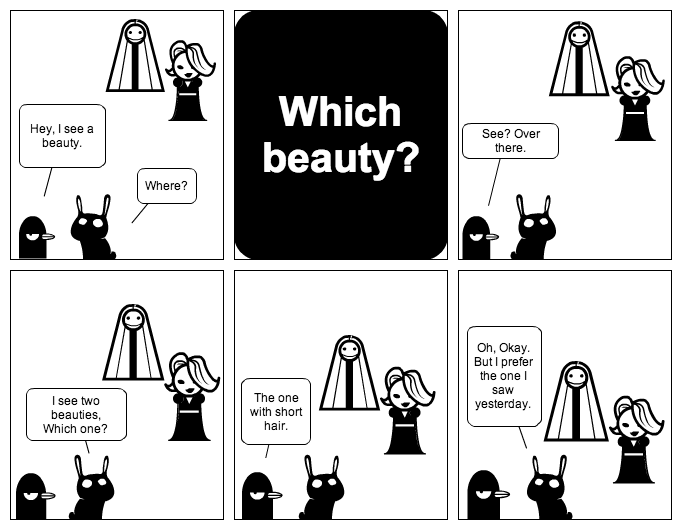
In this dialog, students will see how English article is used in a context. They will notice there are different articles, like a (beauty), the (one), zero article in front of two beauties, added in front of the reference. By reading the dialog, students will get a better understanding of this grammar feature.


Sunday, November 3, 2013

Tell us about your story

The forms of storytelling are varied from traditional oral narratives from up-to-date storytelling via interactive media or digital tools and technologies, which is also called digital storytelling. According to Wikipedia, digital storytelling refers to "a short form of digital media production that allows everyday people to share aspects of their life story". An effective digital storytelling incorporates elements of text, video, audio, music and pictures, and can be interactive.

The digital storytelling is also pedagogically applicable. It is a powerful tool for instruction and consolidation of course content for teachers. Educational Uses of Digital Storytelling suggests that teachers could use it to present new materials by creating new stories, and, in so doing, to motivate students in engaging learning activities and exploring new ideas and topics. In addition, since some of the teachers may find it is difficult to perfectly integrating multi-media into their instruction, storytelling is a good way of consolidating course content by making abstract concepts more concrete and by involving students into discussion. Besides, digital storytelling can be an effective learning tool for students. Through creating their own story, students will develop communication skills such as to “organize their ideas, ask questions, express opinions, and construct narratives”. What’s more, they will gain valuable experience by researching a topic and then choosing a particular point of view. Also, a collaboration work on digital storytelling provides a platform for students to learn learning styles from each other and to share learning resources.


Except for the pedagogical means to use digital storytelling mentioned above, it also benefits me in my future teaching. Firstly, it is a pool of cultures that students share with each other. Students, through first person narrative, would identify salient features from their own cultures, arrange materials at hand, tell their story and demonstrate to others. In the storytelling process, students’ cultural identities are gradually established; by being exposed in dynamic culture contexts, students will experience authentic cultures in this way. Secondly, digital storytelling is used as a reflection of students’ learning experience. When students are asked to think about their identities as language learners, they are required to trace back what they did to contribute to language learning process. In doing so, teachers and students will gain a knowledge of their cognitive development in language area, which enables teachers to provide feedback for their future learning and allows students to see personal ownership and accomplishment.

Sunday, October 13, 2013

Educational Entertainment


A serious game, according to Wikipedia, is defined as “a game designed for a primary purpose other than pure entertainment.” The Garbage Game is a telling example of this kind. Its primary goal is to come up with a plan about how to dispose garbage in NYC. In this game, the player is required to choose one out of three or four solutions for each question about how to deal with certain kind of garbage. At last, a summarization of possible results according to a plan is provided. The results varied from player to player, as shown by the pictures.

Students’ language learning would benefit from finishing this game. One patent objective is to comprehend the situation or the current question, since answering each question requires extensive reading skill. Also, after each answer has been chosen, a description resulted from the answer is provided for players. This format is educational rather than of pure entertainment. Another objective is to have the student to write a report about their own plan, using answers to each question, the descriptions afterwards, and the data in the summarization part. This game would be well adjusted to accomplish reading and writing goals in this way.


In order to see whether the objectives are achieved, the final report serves an efficient assessment. A meaningful report requires 1) the data resulted from 2) the solutions to tackle 3) each problem or issue. Of course, the premise of this job is to, by extensive reading, understand issues involved in this game, so that the player’s production would make sense.